KubeCon China 2026 Guide: Schedule, Tickets, and Shanghai Travel
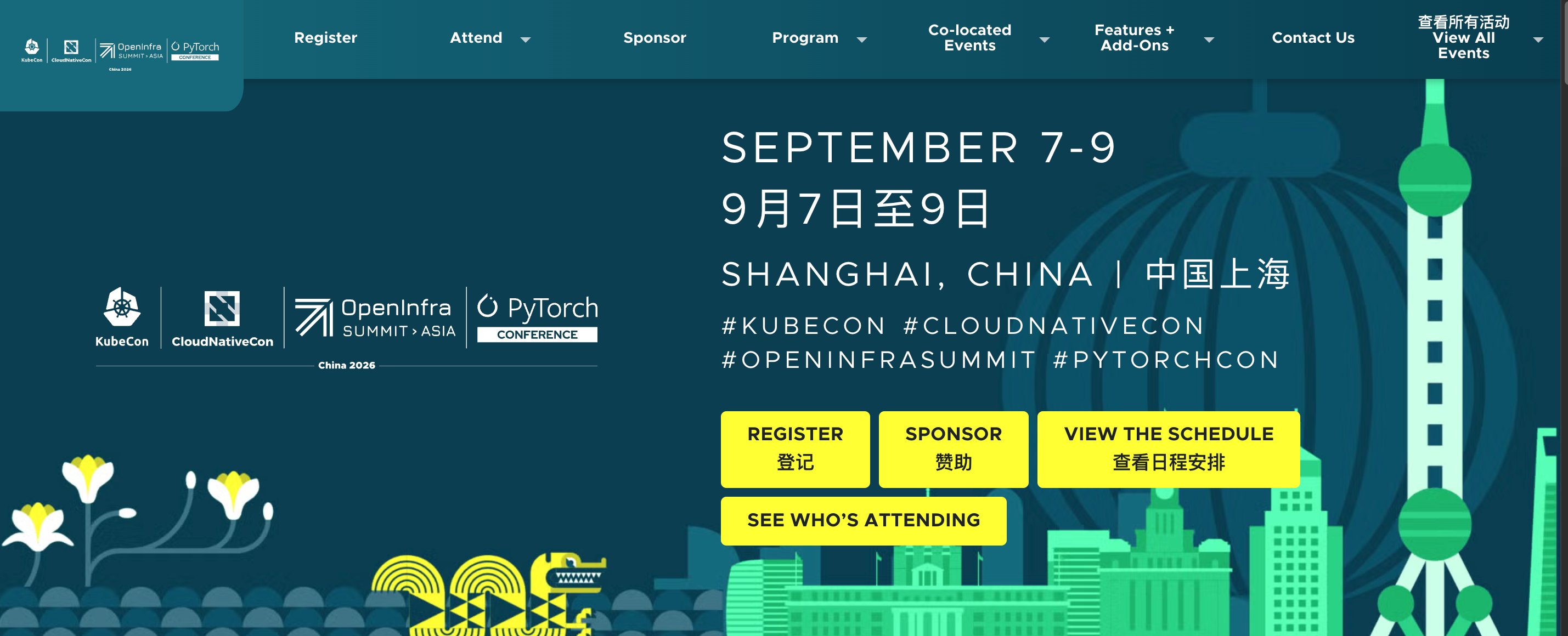
KubeCon + CloudNativeCon + OpenInfra Summit + PyTorch Conference China 2026 takes place September 7–9 in Shanghai.
- Venue: Shanghai International Convention Center
- Address: No. 2727 Riverside Avenue, Pudong (near Lujiazui Metro Station)
This is the first time CNCF, OpenInfra, and PyTorch — three global open source communities — share one stage in China. The program stretches from OpenStack, storage, and virtualization through Kubernetes platform engineering to PyTorch, vLLM, inference, and agentic AI.
That breadth is the event's main advantage and its biggest planning problem. You could spend two days entirely on AI infrastructure, follow project maintainers from session to session, or focus on production reliability — and see a completely different conference from your colleague.
The way to cut through it? One sentence: Start with the problem you want to solve, then use tracks, project tables, and hallway conversations to connect the layers around it.
Why Kubernetes, OpenInfra, and PyTorch Are Sharing One Event
This is not merely a branding exercise. Production AI crosses boundaries that were often discussed by separate communities:
- PyTorch and related frameworks — model development and execution
- Kubernetes — service scheduling and accelerator-aware workload orchestration
- OpenInfra projects — underlying compute, virtualization, networking, storage, and isolation
- Observability, security, data movement, and developer platforms — glue the layers together
For teams that have moved beyond an isolated AI proof of concept, this conference is especially valuable. A model may work fine on one workstation, but when multiple teams need GPUs, data access, versioned deployments, autoscaling, workload isolation, and predictable inference latency — operations get hard. The joint program lets you follow one production problem through more of the stack instead of blaming the model every time something breaks.
| Community | Coverage |
|---|---|
| KubeCon + CloudNativeCon | Kubernetes, platform engineering, operations, observability, networking, security, CNCF project ecosystem |
| OpenInfra Summit | OpenStack, Kata Containers, infrastructure provisioning, virtualization, storage |
| PyTorch Conference China | Training, inference, model systems, accelerators, performance engineering, open source AI lifecycle |
You don't need equal expertise in all three areas. The useful question is: which adjacent layer is currently holding you back? A platform engineer might attend PyTorch sessions to understand workload behavior, while an ML engineer might sit in on scheduling and storage talks to learn why a deployment performs differently from a notebook.
Dates, Venue, and Schedule
The event runs September 7 (Monday) through September 9 (Wednesday), 2026 at the Shanghai International Convention Center. September 7 is reserved for co-located events; the main conference program runs on September 8 and 9.
| Date | Program | Note |
|---|---|---|
| Sep 7 (Mon) | Co-located events | Separate registration or add-on may be required |
| Sep 8 (Tue) | Keynotes, breakouts, tutorials, Solutions Showcase | First full day of the main technical conference |
| Sep 9 (Wed) | Keynotes, breakouts, Solutions Showcase, project activities | Protect time for follow-up conversations and project tables |
Venue: Shanghai International Convention Center, No. 2727 Riverside Avenue, Pudong. The official schedule uses China Standard Time (UTC+8). Seating is first come, first served.
Tip
Check the latest event overview before traveling — rooms, session times, and onsite procedures may change.
Choosing the Right Registration Type
The main conference offers Corporate, Individual, and Academic registration. These categories are based on employment and payment status, not technical seniority.
| Type | Who it's for | Late rate (as of Sep 1) |
|---|---|---|
| Corporate | Employer-paid, including for-profit companies and government organizations | $299 / ¥2,120 |
| Individual | Not employed by a company, nonprofit/research institution staff, or self-paying attendees | $99 / ¥700 |
| Academic | Full-time students and faculty/staff with valid institutional documentation | $50 / ¥355 |
Warning
These are late rates as of September 1 and may change. Verify current prices and availability on the official registration page before purchase.
Main-conference registration includes keynotes, breakout sessions, tutorials, networking activities, access to the Solutions Showcase and Project Pavilion, refreshments, a conference T-shirt, and on-demand session recordings. It does not automatically include the September 7 co-located events — treat the main pass and any add-on as separate decisions.
Pick Tracks by Problem, Build Schedule by Outcome
Pick Tracks: Start With Your Problem
The official program spans more than ten tracks. Sampling every category usually creates a fragmented day. Choose one primary track + one adjacent track + a few wildcard sessions.
| If your problem is... | Primary track | Adjacent track |
|---|---|---|
| GPU utilization, distributed training, kernels, or inference speed | AI Infrastructure + Accelerators & Performance Engineering | Hardware Enablement / Operations & Observability |
| RAG, agents, model serving, or data pipelines | AI + ML + Agentic AI + Data Systems | Application Development / Security |
| Multi-tenant K8s platforms and developer self-service | Platform Engineering + Cloud Native Architecture | Security / Operations & Reliability |
| Private cloud, OpenStack, storage, and virtualization | Cloud Infrastructure + Virtualization & Storage | Networking & Edge / Platform Engineering |
| Supply chain security, isolation, identity, or confidential computing | Security + Privacy & Trusted Computing | Cloud Infrastructure / Application Development |
| Joining or contributing to open source projects | Community + Open Source + Getting Started | Maintainer Track / Project Lightning Talks |
Tip
Track labels are a navigation aid, not a hard boundary. The most relevant talk for an AI platform team might sit under storage, security, or hardware rather than AI. Browse the official track descriptions before choosing sessions.
Build a Schedule: Five Principles
Before you start, write down three questions you want the conference to answer. For example: How are other teams sharing accelerators fairly? What does reliable model serving look like under burst traffic? Where should tenant isolation begin? How are maintainers testing upgrades? Having these questions makes it easier to choose between two attractive sessions in the same time slot.
- Pick one anchor session per block — favor a talk that directly addresses a current project or decision.
- Save a nearby alternative — seating is first come, first served; a full room shouldn't waste a block.
- Include one cross-layer session — step outside your normal role to understand an upstream or downstream constraint.
- Reserve hallway time — a ten-minute conversation with a maintainer or practitioner may answer a narrower question than a general talk can.
- Don't optimize for recordings — sessions will be posted later; spend in-person time on live questions, project contacts, and discussions that cannot be replayed.
Use the official schedule to filter sessions and build a personal agenda. Save essential sessions offline and record the room, not only the title. A screenshot is useful if venue connectivity is busy or account syncing fails.
Whether September 7 Co-Located Events Are Worth Adding
September 7 is not a lighter preview of the main conference. It hosts separate events with their own focus and registration requirements. Add one only if its audience and subject align with your role; otherwise use the day for travel, preparation, or focused meetings.
AGNTCon + MCPCon China (Sep 6–7)
Focuses on the agentic stack: MCP and other protocols, infrastructure, orchestration, production systems, security, and observability. Most relevant to developers, researchers, maintainers, platform teams, and enterprises actively building agent systems. Pre-registration is required through the event's own process.
OSPOlogy + OSPO Summit China (Sep 7)
Focuses on open source program offices (OSPOs), corporate governance, LLM and data governance, AI-assisted software supply chains, and enterprise open innovation. Better suited to OSPO leaders, legal and compliance partners, community strategists, and engineering leaders responsible for how an organization consumes and contributes to open source.
Warning
Don't assume a main-conference ticket grants access. Confirm the add-on status, price, and registration path through the official event site. If both topics sound relevant, choose the one tied to an actual decision you expect to make in the next quarter.
Project Tables and Maintainer Sessions
The Project Pavilion is one of the strongest reasons to attend in person. Project tables let you meet maintainers directly: ask implementation questions, understand contribution paths, and discover whether a project fits a real constraint. But the conversation becomes more useful when you bring context instead of asking for a general product tour.
Before you walk up to a table:
- Be ready to describe your workload, cluster size, version, and failure mode in one minute
- Separate reproducible project issues from vendor-specific configuration problems
- Ask where maintainers prefer to handle issues, design discussions, documentation fixes, and user support
- Record the relevant repository, SIG, working group, Slack channel, or meeting
- Don't expect maintainers to debug sensitive production data at a public table
Key timings:
- Project Lightning Talks — September 8
- Maintainer Track — Tuesday and Wednesday
- Solutions Showcase project tables — Tuesday and Wednesday
Review the official project engagement options and note when the maintainers you want to meet will be present.
DaoCloud will have engineers stationed at the S2 main booth and multiple open source project tables. Come by and chat.
| Date | Booth | Area | Hours |
|---|---|---|---|
| Sep 7 (Mon) | S2 | Main exhibition area (setup) | 18:00–20:00 |
| Sep 8 (Tue) | S2 | Main exhibition area | 10:30–13:00 / 13:00–17:30 |
| Sep 8 (Tue) | T3 | LWS open source booth | 10:30–13:00 / 13:00–19:00 |
| Sep 9 (Wed) | S2 | Main exhibition area | 10:30–13:00 / 13:00–15:30 |
| Sep 9 (Wed) | S2 | Main exhibition area (teardown) | 15:30–17:00 |
| Sep 9 (Wed) | T7 | llm-d open source booth | 10:30–15:30 |
| Sep 9 (Wed) | T8 | Spiderpool open source booth | 10:30–15:30 |
| Sep 9 (Wed) | T10 | HwameiStor open source booth | 10:30–15:30 |
| Sep 9 (Wed) | T13 | Kubean open source booth | 10:30–15:30 |
Tip
DaoCloud open source projects: HwameiStor (cloud-native storage), Spiderpool (K8s IPAM), Kubean (cluster lifecycle management), LWS (LeaderWorkerSet), llm-d (LLM inference scheduling), HAMi
More info: DaoCloud | d.run compute platform
DaoCloud: 7 Technical Talks and Booth Information
When AI workloads move into production, the real challenges begin: How do you schedule expensive GPUs more efficiently? How do you quickly find the root cause of slow inference? How must Kubernetes evolve to handle increasingly complex AI workloads?
DaoCloud brings 7 technical talks to the conference, organized along three directions.
In the past, scheduling GPUs only required answering one question: "Which machine still has a card?" That's nowhere near enough now — GPU, NIC, NUMA, PCIe, NVLink, Fabric, network topology, and even the relationship between Prefill and Decode all affect whether an inference task can run efficiently.
Talk 1: Teaching Kubernetes to Truly "Understand" Complex AI Resources
Speaker: Xu Junjie (Paco) — Head of Open Source at DaoCloud, Kubernetes Steering Committee member
Starting from the full architecture of Kubernetes DRA (Dynamic Resource Allocation), this talk connects the latest DRA-related KEP progress across v1.36–v1.37. See how K8s is moving from "allocating GPUs" toward understanding and scheduling complex heterogeneous resource relationships. With NVIDIA Dynamo / GB200 optimization practices, it shows how IMEX allocation latency in thousand-GPU clusters was reduced from minutes to seconds.
Talk 2: Why Can't a Deployment Hold an LLM Inference Service Anymore?
Speaker: Yan Kai — Chief Architect at DaoCloud
In distributed LLM inference, a complete inference replica consists of multiple Pods spanning nodes and GPUs. If only some Pods are scheduled successfully, the service can't start — and may prematurely hold a large amount of GPU resources. The P/D disaggregation scenario makes it even more complex: Prefill and Decode need independent autoscaling while coordinating scheduling.
This talk dives into the latest evolution of LeaderWorkerSet (LWS), unpacking Gang Scheduling and Disaggregated Set — how K8s makes multiple Pods "go together or not at all" and unifies management of two distinct workload groups.
GPU utilization looks fine, but TTFT went up — is it Prefill queueing? Decode? KV Cache? Network? Or the GPU itself? These three talks focus on pushing inference systems from seeing anomalies to finding root causes.
Talk 3: Don't Wait Until GPUs Are Running to Discover Environment Problems
Speaker: Pan Yuanhang (Peter) — VP of Product at DaoCloud
A Preflight pre-launch health check mechanism based on LWS, using init-containers to pre-check compute environment, GPU communication, RDMA network, and runtime dependencies before the inference task actually starts. In thousand-GPU clusters, catching failures before resources are occupied is an increasingly real cost equation.
Talk 4: TTFT Tells You "It's Slow" — But Not "Why"
Speaker: Liu Qijun, Li Hui — AI Engineers at DaoCloud
A unified performance diagnosis method for P/D disaggregated inference, using a small set of high-value metrics to build a "metric → root cause → tuning action" linkage. Turns performance monitoring into a diagnostic system that directly guides Batch Size, KV Policy, RDMA, and topology optimization.
Talk 5: Tracing a Single Request All the Way to the GPU Kernel
Speaker: Chen Minquan, Tan Jian — R&D Engineers at DaoCloud
End-to-end observability for LLM inference: connecting inbound traffic, Inference Gateway, vLLM / SGLang, and model Runtime all the way to GPU metrics. Three real production problems — Why did P99 suddenly spike? Why does the GPU look busy but isn't doing effective work? Why did KV Cache suddenly OOM? — reducing hours of troubleshooting to minutes.
Must Pod restarts go through the entire lifecycle? Can K8s only schedule compute resources? Should compute, storage, and network continue to be managed separately? These "old questions" become new problems affecting scale and efficiency in the AI era.
Talk 6: 5,000 Nodes — Why Does a Restart Take 2 Minutes?
Speaker: Fan Baofa — R&D Engineer at DaoCloud
Systematically breaks down "first start" and "restart" within the same Workload Lifecycle. Key result: JobSet Replacement Restart at 5,000-node scale reduced restart time from 2 minutes 10 seconds to 10 seconds. Those two minutes saved are exactly what K8s needs to solve for large-scale AI Workload recovery.
Talk 7: What If Kubernetes Schedules Not Just Compute, but "Compute, Storage, and Network"?
Speaker: Lan Weizhou — Senior Technical Lead at DaoCloud
Cybertwin-based Cloud Native Network (CCNN) architecture exploration: using Kubernetes as a Network OS to unify virtualization, scheduling, and management of compute, storage, and network resources. With zero-trust Personal Agent, data and communication Agent, and distributed collaborative inference scenarios. As the scheduling center shifts from "machine" to "application," should network also become a resource that K8s can dynamically orchestrate, just like GPUs?
Networking: Bring Questions, Not Job Titles
The efficiency of conference networking depends on how specific your introduction is. "We're moving batch inference onto K8s and comparing scheduling approaches" — the other person immediately knows who you are, what you do, and what you might discuss. A list of job titles and technology names doesn't do that.
Three steps:
- Before the event — identify a few speakers, maintainers, or teams whose work intersects with yours; read the abstract or repository first
- During the event — ask one focused question, respect their time
- After the event — write a short note explaining why the contact matters, send promised follow-ups while the discussion is still fresh
The official FAQ points attendees to the CNCF Slack workspace and its hallway channel. Onsite activities also include a welcome reception, a Women's Gathering, peer group mentoring, and a PyTorch community night. Some activities have limited capacity or require an RSVP — check the conference experiences page before arrival.
What to Bring
Two dense technical days, a venue full of parallel conversations. Pack light with a reliable note-taking system — it beats carrying a "mobile office."
| Item | Notes |
|---|---|
| Registration confirmation and ID | Local + offline copies of essential travel and entry documents |
| Laptop (only if necessary) | Phone or tablet may suffice; laptop adds weight and charging needs |
| Power bank and cables | Your schedule, messages, translation tools, and maps all depend on battery |
| Reusable water bottle | Hydration improves concentration across long session blocks |
| Business cards or QR contact card | Make sharing the right professional profile easy |
| Light layer and comfortable shoes | Indoor temperatures and walking distances can vary a lot |
| Short technical question list | Include project versions and non-sensitive architecture context |
Danger
Don't carry production credentials, unrestricted kubeconfig files, private datasets, or confidential diagrams just because you might discuss work. Use sanitized examples and a restricted travel device per your organization's security policy.
Shanghai Travel Guide
Venue: Shanghai International Convention Center, No. 2727 Riverside Avenue, Pudong.
Airport distances (official estimates):
| Origin | Road distance | Notes |
|---|---|---|
| Pudong International Airport (PVG) | ~55–60 km | Travel time depends on traffic |
| Hongqiao International Airport (SHA) | ~18–20 km | Same as above |
Don't schedule a critical session right after a flight or train — leave a generous arrival margin.
The official conference hotel block has closed. When booking alternatives, compare three things: location, cancellation terms, and the actual morning commute route. A cheaper room that requires gambling on cross-city traffic may cost more in missed sessions and spent energy. Verify the address in both English and Chinese, save it offline, and reference the official venue and travel guidance.
International visitors — confirm before departure:
- Passport validity and entry requirements
- Payment methods (mobile payment is nearly universal in China; international cards are not always accepted)
- Mobile connectivity (eSIM or local SIM card)
- Access to tools required for work
Tip
If you need a visa support letter, follow the event's official request process — don't use a generic invitation template.
Post-Event: Turn Notes Into Experiments
"Research later" — this phrase kills more conference inspiration than anything else.
Within a week, pick one idea and reduce it to a testable question: compare two Ingress configurations, reproduce an observability pattern, deploy a small model service, evaluate a sandbox boundary, or test storage behavior under failure. Record software versions, assumptions, commands, metrics, and rollback steps.
A laptop VM or an existing server is enough for many first experiments. If you want a reusable multi-node environment, compact cluster build examples show how small x86 nodes can be organized for distributed systems learning.
Conference Planning Checklist
- Confirm registration type: Corporate / Individual / Academic
- Decide whether a Sep 7 co-located event serves a real goal
- Check visa, travel, and employer approval requirements
- Review cancellation, substitution, and documentation policies
- Build a personal agenda with a Plan B for each important block
- Mark relevant project tables, maintainers, and speakers
- Save venue address, registration confirmation, and agenda offline
- Remove unnecessary credentials and sensitive files from travel devices
- Prepare three questions and a concise introduction
- Send promised links and follow-up messages within two business days
- Group notes by decisions / experiments / people / resources
- Watch recordings for sessions missed onsite
- Turn one idea into a documented, reproducible test
- Share findings with the team instead of forwarding a pile of slides
FAQ
What is the official name of the event?
KubeCon + CloudNativeCon + OpenInfra Summit + PyTorch Conference China 2026. It combines CNCF, OpenInfra, and PyTorch community content in one flagship event.
When is it held?
September 7–9, 2026. September 7 hosts co-located events; keynotes, breakouts, tutorials, and the Solutions Showcase run September 8–9.
Where is it held?
Shanghai International Convention Center, No. 2727 Riverside Avenue, Pudong, Shanghai, China.
Is there an online option?
There is no live virtual component. Keynote and breakout recordings will be published on the CNCF YouTube channel within two weeks after the event.
Are sessions in Chinese or English?
The program includes both regional and international speakers. The official FAQ says captioning with translations will be available for keynotes and breakout sessions. Check individual session details and onsite instructions for available language options.
Does a main ticket include co-located events?
No. Main registration includes conference content and the Solutions Showcase but does not automatically include co-located events. Confirm the separate registration or add-on required for your chosen September 7 event.
Who qualifies for an Individual ticket?
People not currently working for a company, those employed by a nonprofit or research institution, or attendees paying personally rather than being funded by an employer. Applications are reviewed and may require additional information.
Can beginners attend?
Yes. The Community + Open Source + Getting Started track is designed in part for newcomers, students, career changers, and people learning how to participate in the ecosystem. Beginners benefit from defining a small number of topics rather than trying to understand every project.
How should an AI engineer choose between PyTorch and Kubernetes sessions?
Start with the bottleneck in your current workflow. Choose PyTorch, inference, or accelerator sessions for model execution and performance questions; choose Kubernetes, platform, storage, security, or observability sessions when the problem appears during deployment and operations.
Will sessions be recorded?
Yes. The official schedule says sessions will be available on the CNCF YouTube channel within two weeks. This makes it reasonable to prioritize live discussions and watch conflicting talks later.
How early should I arrive for a popular session?
Seating is first come, first served, and demand is difficult to predict. Leave enough time after the previous activity to reach the room, and keep a nearby alternative saved in case seating fills.
What should I ask at a project maintainer table?
Bring a focused, non-sensitive question with the relevant project version, workload context, and what you have already tested. Ask where the project handles user support, issues, design discussions, and contributions so the conversation can continue in the correct channel.
Does the event provide accessibility and dietary support?
The organizers provide inclusion and accessibility guidance, translated captioning, and several dietary options. Special meal needs and individual accommodations should be submitted through the official process early — some arrangements cannot be made onsite.
Is PyTorch Conference China only for model researchers?
No. The combined program also addresses inference, production systems, accelerators, platform engineering, data infrastructure, observability, and deployment. ML engineers, systems engineers, platform teams, and infrastructure architects can follow different parts of the same AI lifecycle.