Installation
This page describes how to install the Copilot workbench offline and online. The Chart name is copilot, and it is published in the Helm repository https://release.daocloud.io/chartrepo/agentclaw.
Info
Installer v0.45.0 and later can install Copilot, including a GitOps install and ExistingSecret. The steps below install this Helm Chart on its own. For supported Kubernetes versions, see Compatibility.
Installation Parameters
| Item | Value |
|---|---|
| Chart | copilot |
| Helm repository | https://release.daocloud.io/chartrepo/agentclaw |
| Release name | tokenfactory-copilot |
| Namespace | copilot-system |
| Deployment / Service | tokenfactory-copilot |
| Example Chart version | 0.3.0-rc2 |
The commands below use Chart 0.3.0-rc2. Before installing, run helm search repo agentclaw/copilot --versions --devel and replace that version in the commands and in the offline export config. Without --devel, the search omits prereleases such as 0.3.0-rc2. After the repository publishes a higher version without -rc, replace 0.3.0-rc2 in the examples below with that stable version. Each runtime image tag is v plus the Chart version, so Chart 0.3.0-rc2 uses tag v0.3.0-rc2. Replace the three tags together:
release.daocloud.io/agentclaw/deepseek-harness:v0.3.0-rc2release.daocloud.io/agentclaw/copilot-skills:v0.3.0-rc2release.daocloud.io/agentclaw/copilot-bigscreen:v0.3.0-rc2
Do not replace only one of these images.
Prerequisites
-
See Compatibility for Kubernetes versions.
-
The default install publishes the entry through the platform subpath, so the cluster needs ghippo.
global.gproduct.positionTypedefaults toheader-action, which requires ghippo v0.48.1 or later. For an older ghippo, set it tonormal: -
The Chart creates a NetworkPolicy that allows only the
istio-systemnamespace to reach the workload. If the platform gateway is in another namespace, setnetworkPolicy.ingressNamespaceto that namespace, or setnetworkPolicy.enabledtofalse. -
Prepare a model API key. Put it in a Secret before installing the Chart, and keep it out of Helm values:
kubectl create namespace copilot-system
kubectl -n copilot-system create secret generic tokenfactory-copilot-credentials \
  --from-literal=OPENAI_API_KEY='<api-key>'
The default model endpoint is
https://api.deepseek.comand the model ID isdeepseek-flash. With that endpoint, web search reuses the sameOPENAI_API_KEY. If you point the model at another endpoint, web search still calls the official DeepSeek API and needsDEEPSEEK_API_KEYin the same Secret. -
Set
dsh.entrypointto the address browsers use to open the platform. Include only the scheme and host, with no path, for examplehttps://platform.example.com. After it is set, the proxy accepts browser requests only from that origin and returns 403 for any other origin. When it is left empty, the requestOriginmust matchHost.
Set these values during installation:
| Parameter | Example | Description |
|---|---|---|
dsh.model.existingSecretRef | tokenfactory-copilot-credentials | Secret that contains OPENAI_API_KEY. It takes precedence over an inline key |
dsh.entrypoint | https://platform.example.com | Platform address, scheme plus host |
Setting dsh.model.apiKey directly also starts Copilot. The key is then stored in the Helm release, so this is not recommended.
Offline Installation
Online installation uses the Chart repository https://release.daocloud.io/chartrepo/agentclaw, which can be read without logging in. The download center does not yet publish a Copilot offline package. On a machine that can reach this repository, export a bundle with charts-syncer and copy it to the target environment. After the download center publishes an offline package, use that package. The loading steps below stay the same.
Export the Offline Bundle
The agentclaw repository also contains other Charts. Select only copilot so unrelated images are not packed into the bundle.
-
Create
save-bundles.yaml.save-bundles.yamlrelocateContainerImages: true source: repo: kind: HARBOR url: https://release.daocloud.io/chartrepo/agentclaw target: intermediateBundlesPath: copilot-offline charts: - name: copilot versions: - 0.3.0-rc2If pulling images requires a login, set the registry, username, and password under
source.containers.auth. Replace0.3.0-rc2with the Chart version to export. -
Export the bundle.
Copy the bundle from the
copilot-offlinedirectory to the target environment. Use it as the input of the next step. Do not runhelm installon it directly.
Load Images and the Chart from the Bundle
When the environment has an image registry, sync with charts-syncer. When there is no Chart repository and the package contains images.tar, load the images on the nodes with Docker or containerd.
Sync to an Image Registry with charts-syncer
-
Create
load-image.yaml.Note
Replace the addresses, username, and password with those of the target registry.
intermediateBundlesPathis relative to the directory where you run charts-syncer.load-image.yamlsource: intermediateBundlesPath: copilot-offline # (1)! target: containerRegistry: 10.16.10.111 # (2)! containerRepository: release.daocloud.io/agentclaw # (3)! repo: kind: HARBOR url: http://10.16.10.111/chartrepo/release.daocloud.io # (4)! auth: username: "admin" # (5)! password: "Harbor12345" # (6)! containers: auth: username: "admin" # (7)! password: "Harbor12345" # (8)!- Path relative to the charts-syncer command
- Target image registry
- Project path in the target image registry
- Target Chart repository URL
- Chart repository username
- Chart repository password
- Image registry username
- Image registry password
load-image.yamlsource: intermediateBundlesPath: copilot-offline # (1)! target: containerRegistry: 10.16.10.111 # (2)! containerRepository: release.daocloud.io/agentclaw # (3)! repo: kind: LOCAL path: ./local-repo # (4)! containers: auth: username: "admin" # (5)! password: "Harbor12345" # (6)!- Path relative to the charts-syncer command
- Target image registry
- Project path in the target image registry
- Directory for the Chart package
- Image registry username
- Image registry password
-
Sync the images and the Chart.
charts-syncer rewrites the image addresses in the Chart. When installing that rewritten Chart, do not override the image registry parameters.
Load Directly with Docker or containerd
If the extracted package contains images.tar (usually together with hints.yaml and original-chart), load it on every node. Sync the intermediate bundle exported by charts-syncer into a registry with the previous section instead of loading it here.
-
Extract the package.
-
Load the images.
Note
Load the images on every node, then tag them to the registry address used at install time. When you tag them yourself, image.registry, copilotArtifacts.skillsImage.registry, and copilotArtifacts.bigscreenImage.registry must match the tagged address. The default is release.daocloud.io/agentclaw, which already includes the registry project path.
Offline Installation Steps
Create the Secret from Prerequisites, then install the Chart.
Install Through the Kpanda UI
In Helm Apps, refresh the offline repository and open the copilot Chart. Set the release name to tokenfactory-copilot, the namespace to copilot-system, and set dsh.entrypoint and dsh.model.existingSecretRef.
Install with Helm
Replace <chart> with copilot from the private repository, or with the Chart package in the output directory when the target kind is LOCAL. Include --version when installing from a repository. You can omit it when installing a local Chart package.
helm upgrade --install tokenfactory-copilot <chart> \
  --namespace copilot-system \
  --version 0.3.0-rc2 \
  --set-string dsh.entrypoint='https://<platform-address>' \
  --set-string dsh.model.existingSecretRef=tokenfactory-copilot-credentials
Online Installation
Info
The prerequisites for online installation are the same as for offline installation.
Install Through the Kpanda UI
In Helm Apps -> Helm Repositories, add https://release.daocloud.io/chartrepo/agentclaw. Then open Helm Templates, find the copilot Chart, and install it. Set the release name to tokenfactory-copilot, the namespace to copilot-system, and set dsh.entrypoint and dsh.model.existingSecretRef.
Install with Helm
helm repo add agentclaw https://release.daocloud.io/chartrepo/agentclaw
helm repo update
helm search repo agentclaw/copilot --versions --devel

helm upgrade --install tokenfactory-copilot agentclaw/copilot \
  --namespace copilot-system \
  --version 0.3.0-rc2 \
  --set-string dsh.entrypoint='https://<platform-address>' \
  --set-string dsh.model.existingSecretRef=tokenfactory-copilot-credentials
Replace 0.3.0-rc2 with the version you select from helm search.
Access
The platform subpath is enabled by default. After installation, open https://<platform-address>/copilotui/ in a browser. The platform navigation opens that address in a new window.
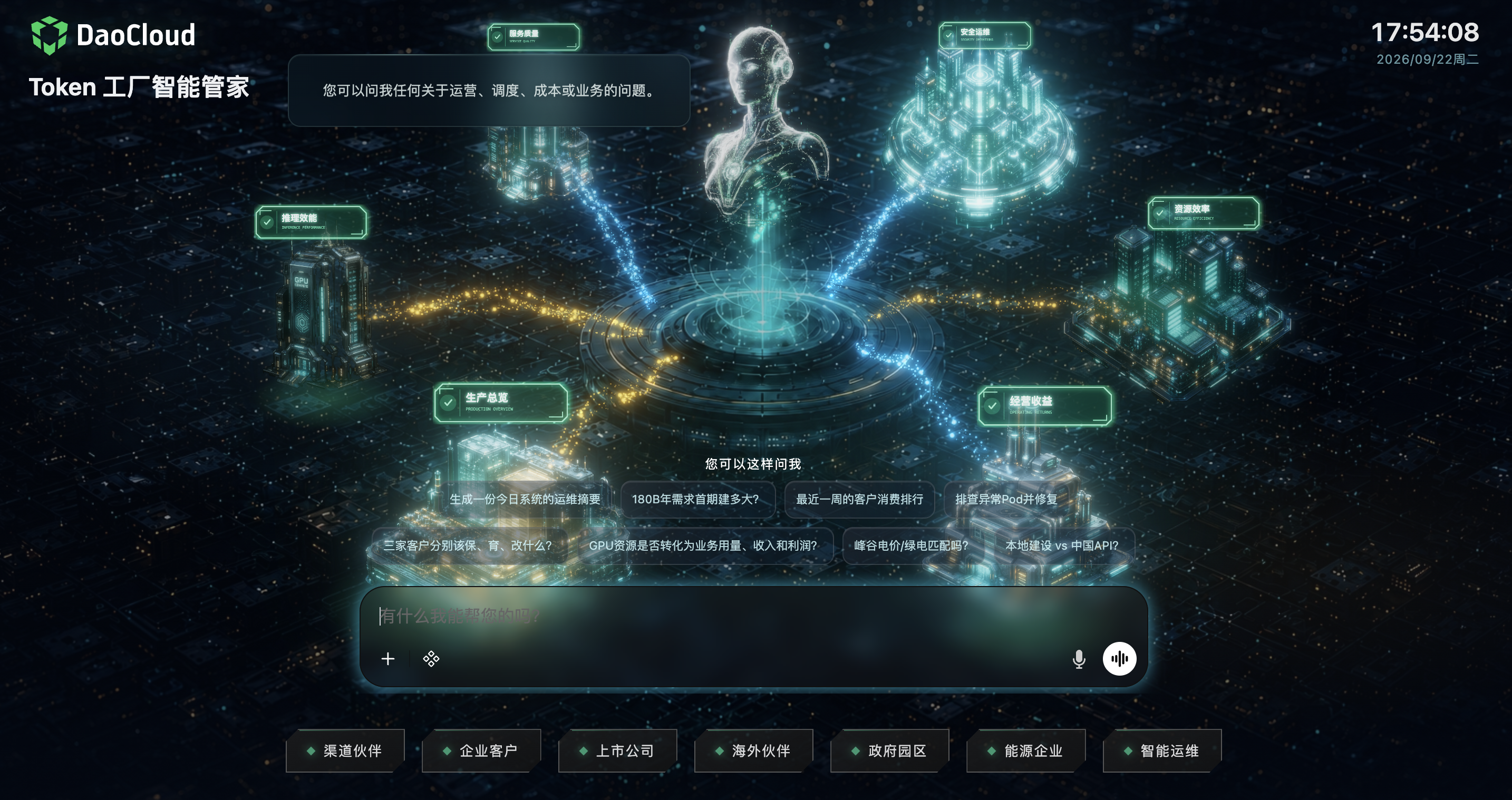
On first startup, DeepSeek Harness prints a one-time URL in the logs. Do not paste the token from that URL into a ticket or chat:
Warning
The browser UI has no per-user isolation. Anyone who can open the page uses the same agent. The default dsh.permissionMode is danger-full-access, so the agent can run commands inside the Pod. Keep the model key and network access narrowly scoped. The Pod does not mount a ServiceAccount token.
Optional Settings
CLI Credentials
Querying business data requires platform CLI credentials. Use an account that can only query. The Chart mounts hosts.yml read-only at $HOME/.config/dce/hosts.yml.
Create a token in the platform console under User Center -> API Token. The Chart can then render the Secret. The rendered file uses user: admin and insecure: true:
To keep the token out of Helm values, use an existing Secret. That Secret takes precedence over host and oauthToken.
kubectl -n copilot-system create secret generic tokenfactory-dce-hosts \
  --from-file=hosts.yml="$HOME/.config/dce/hosts.yml"
dceAuth is the credential used by the CLI. On the platform subpath, signing in to the page with a platform account is controlled by global.gproduct.proxy.dceLogin, which is enabled by default and is separate from dceAuth. global.gproduct.proxy.authnCheck defaults to false. Setting it to true also requires dceLogin to be enabled.
Session Persistence
persistence.enabled defaults to false. Sessions stay on an emptyDir and are discarded when the Pod is replaced. Enable a PVC to keep sessions. The default is 5Gi, ReadWriteOnce, mounted at /opt/data. The Deployment uses Recreate so two Pods do not mount the same volume.
Each start replaces the copilot-skills directory on the volume. Do not store custom files there.
Dedicated Host
Set global.gproduct.proxy.enabled to false to serve Copilot at the root of dsh.entrypoint. This mode requires Ingress. It has no Ghippo authentication and no platform-account login, so restrict access at the gateway.
helm upgrade --install tokenfactory-copilot agentclaw/copilot \
  --namespace copilot-system \
  --version 0.3.0-rc2 \
  --set-string dsh.model.existingSecretRef=tokenfactory-copilot-credentials \
  --set global.gproduct.proxy.enabled=false \
  --set-string dsh.entrypoint='https://copilot.example.com' \
  --set ingress.enabled=true \
  --set-string ingress.className=nginx
Upgrade
Replace the three image tags together. A tag is v plus the Chart version, for example v0.3.0-rc2. The fields are image.tag, copilotArtifacts.skillsImage.tag, and copilotArtifacts.bigscreenImage.tag.
Upgrade with a complete values file:
helm upgrade tokenfactory-copilot agentclaw/copilot \
  --namespace copilot-system \
  --version 0.3.0-rc2 \
  --reset-values \
  -f values.yaml
Without --version, Helm selects the latest stable chart and skips versions that contain -rc. Set --version to the Chart version that matches the image tags in the values file. A tag is v plus that Chart version.
With --reuse-values, set those three tags explicitly. An existing release also keeps the previous global.gproduct.proxy value, so it stays on a dedicated host. To use the platform subpath, set global.gproduct.proxy.enabled to true.
When upgrading from an earlier version:
copilotArtifacts.clisImageandcopilotArtifacts.pluginsImagehave been removed. Delete them from values.- The model key moves to
dsh.model.existingSecretRefordsh.model.apiKey. While neither new key is set, the Chart still readsexistingSecretRefandsecrets.OPENAI_API_KEY. After either new key is set, that new key is used. - v0.1.x
hermes-agent.dceAuthstill applies when top-leveldceAuthhas nohost,oauthToken, orexistingSecretRef. After any of those top-level fields is set, the top-level value is used.
Starting with DSH 0.2.1, an OPENAI_API_KEY already saved in $DSH_HOME/.credentials.yaml on the volume takes precedence over the Secret. If someone saved that key in the UI, rotating the Secret has no effect until the OPENAI_API_KEY entry under refs in that file is deleted. No restart is required. When checking the file, look only at the key name and do not print the secret.